Have you seen a Medusa tattoo on social media and wondered what’s behind it? It’s not just a striking image: for many people, especially survivors of sexual assault or abuse, this design has become a symbol of strength, protection and recovery. If the idea of getting one is on your mind or you simply want to understand its message, here is a clear, practical guide with key meanings, trends and tips for choosing a design and placement calmly and safely.
What does the Medusa tattoo mean?
The Medusa tattoo is associated with empowerment after traumatic experiences. It serves as a reminder of the courage to move forward and, at the same time, as a talisman of protection against further harm. Its symbolic origin lies in the Greek myth: in the most widespread version, Medusa was assaulted by Poseidon in Athena’s temple, and then transformed into a figure capable of petrifying with her gaze. Some interpret that transformation as a punishment and others read it as a form of protection granted by the goddess.
Beyond the literal reading, Medusa embodies transformation and rebirth: she was changed without consent, but found a form of power in that new state. For this reason, her tattoo represents taking back control and adapting to adversity. Over the centuries her image has shifted from the grotesque to the beautiful, retaining a powerful femininity that many people now reclaim on their skin. If you’re looking for other symbols with similar messages, the semicolon or figures like birds and ribbons that evoke freedom and awareness are also common.
Why is it so popular now?
Social media have amplified this image. On platforms like TikTok, videos showing Medusa tattoos rack up thousands of views, which has helped more people learn their meaning and consider getting one. In addition, the impact of the Me Too movement reduced some of the stigma around talking about assaults and abuse, making many people feel more comfortable sharing their story or the meaning of their tattoo.
Now, not everyone who gets a Medusa tattoo does it for that reason. Some are drawn to Greek mythology or simply to the aesthetics of the design. The key? Don’t assume. If you already have it, chances are most people won’t even stop to interpret its meaning. And if you care about its message, it’s fine for it to be intimate and personal: you decide how much to share.
Styles and designs that work
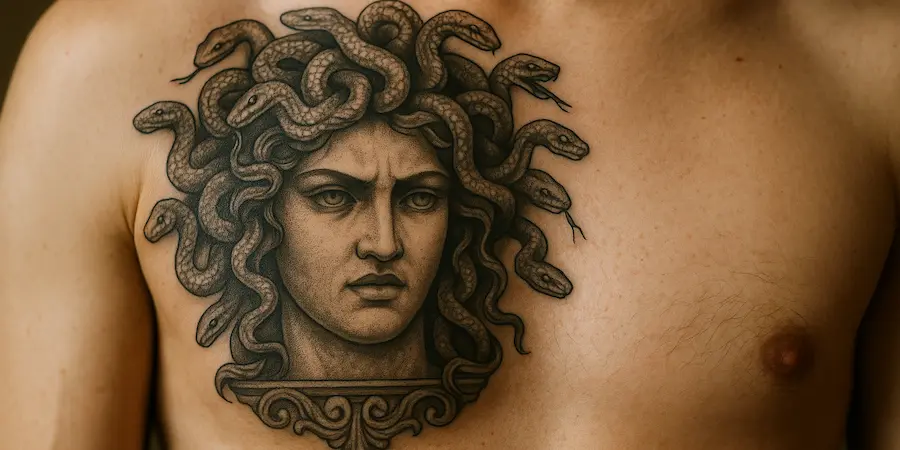
The depiction usually shows Medusa facing forward, with her eyes open and snake-hair well defined. From there, you can adapt the idea to your favorite style: realistic, illustrative, fine-line or dotwork. Due to the amount of detail in the face and hair, these tattoos usually work better in medium or large sizes, either as a standalone piece or integrated into a sleeve.
- Color or black and gray: the most common choice is black and gray, but adding a touch of color in the eyes or on some snakes can give it a personal stamp.
- Full piece or elements: if you prefer something more discreet, you can tattoo just a part (the eyes, a specific snake, a profile) to retain the symbolism without taking up as much space.
- Composition: a frontal framing conveys strength and presence; a profile with subtler snakes can be elegant and minimalist.
Where to place it: visibility and comfort
Placement matters, especially if you’re concerned about exposure. People who know the meaning may ask you about it, and you may not always want to explain, especially in work contexts. If you want to keep it more private, choose areas that are easy to cover.
- Discreet options: inner wrist, ankle, ribs or upper thigh. A reduced motif (the eyes or a snake) fits very well in these areas.
- Prominent pieces: arm, forearm, back or chest allow more detail and depth in the gaze and snake hair.
- Transforming scars or stretch marks: some people use the Medusa design to integrate their marks into an artistic piece. Given its link with transformation and acceptance of one’s body, it can be a powerful way to accompany your story.
Remember: there is no “right” area. Think about your daily life, how much you want it to be seen and what will make you feel more at peace with your decision.
How to choose an artist and have a safe experience
Take your time researching. Look for professionals who master portraits and fine lines, and review previous Medusa works or similar pieces. If it makes you feel more comfortable, prioritize studios and women artists: many people find those spaces especially safe and respectful. The important thing is that you maintain control over the appointment: you set the boundaries and give approval at every step of the design.
- Safe environment: you have the right to a tattoo space where you feel protected and heard. If something doesn’t feel right, say so or change artists.
- Clear communication: bring references, explain which meaning you want to highlight (protection, rebirth, resilience) and agree on size and placement before starting.
- Respect for privacy: if you are an artist, avoid asking the client to justify their tattoo. It’s a vulnerable moment and your role is to accompany with sensitivity.
Still unsure? That’s OK. Sometimes it helps to start with a small element or a less visible location to see how you feel. This tattoo, more than any other, is about reconnecting with your power and your story; take the time you need so the result speaks of you, in your own way.